


Most homeowners in Anaheim turn their attention to the air conditioner when cooling problems appear. The duct system that delivers conditioned air to every room in the house deserves equal attention. Poorly designed or deteriorating ductwork allows conditioned air to escape before it reaches the living space, which directly affects comfort and long-term equipment wear throughout Anaheim’s extended cooling season.
Four Seasons Heating and Air brings that same standard to every HVAC ductwork job in Anaheim. We document every inspection before making any recommendation, and we give homeowners a clear explanation of whether the system needs duct cleaning, repair, or replacement.
Role of Duct Design in Home Cooling
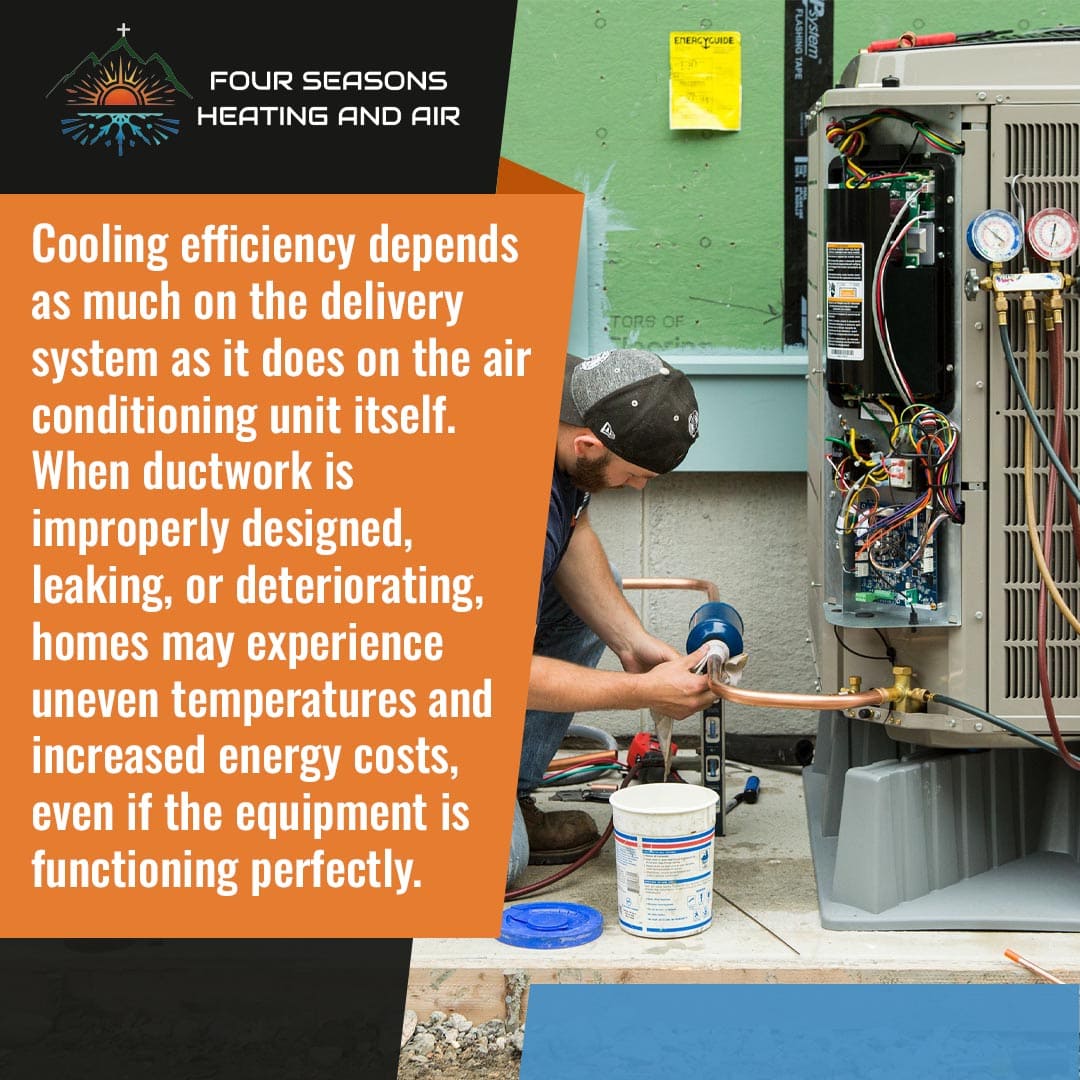
HVAC ductwork is the delivery system for conditioned air. A properly functioning air conditioner cannot perform well if the ducts moving air through the home are undersized, poorly routed, or leaking at connections.
Effective duct design accounts for four key factors:
- Duct sizing matched to the airflow requirements of each room based on square footage and load calculations.
- Duct routing planned to reduce resistance from bends, transitions, and long runs.
- Duct placement positioned to avoid unconditioned spaces, such as hot attics, where heat gain reduces delivery efficiency.
- Sealed connections at every joint, register boot (the metal fitting connecting the duct to the vent opening), and plenum (the central air distribution box attached to the HVAC unit)
When any one of these factors is not properly addressed during installation, the performance of the entire system is affected.
Common Performance Problems Linked to Poor Duct Design
Uneven Room Temperatures
Uneven cooling between rooms points to unbalanced airflow in the duct system. Supply ducts undersized for a particular zone, runs with excessive bends, or a flex duct that has partially collapsed, all restrict how much conditioned air reaches certain areas of the home.
A second-floor bedroom that stays warmer than the rest of the house is a typical example. The duct run serving that room is often longer, passes through a hot attic, and may include multiple directional changes that reduce airflow before air reaches the register.
Weak Airflow at Vents
Weak airflow at a register (the grille or vent cover on your wall, floor, or ceiling where conditioned air enters the room) indicates a restriction in the duct run feeding that vent. The cause may be an undersized duct, a collapsed section of flex duct, or a leak releasing conditioned air before it reaches the intended room.
High static pressure, which is the resistance the blower motor works against to push air through the system, is another contributing factor. It adds cumulative strain to equipment over time and shortens component service life.
Extended System Run Times
A duct system that leaks or lacks proper insulation forces the air conditioner to run longer to reach the set temperature. The California Energy Commission requires new and replacement ductwork to meet insulation standards under Title 24, but many older Anaheim homes predate those requirements entirely.
When the duct system cannot deliver air efficiently, the HVAC unit compensates by running more cycles. This adds wear to mechanical components across months and years of regular use.
Rapid Dust Buildup on Registers
Leaking return ducts can pull in air from unconditioned spaces, which may contribute to dust and particulate infiltration while also creating pressure imbalances that affect overall system performance. Return ducts, which are the lines that draw air back to the HVAC unit for reconditioning, operate under negative pressure. Any unsealed gap or joint pulls in surrounding air along with dust, insulation fibers, or debris from that space.
Homeowners who notice dust returning quickly to registers and surfaces after cleaning may be dealing with a return duct leak rather than a general air quality issue. Searching for duct cleaning near you is a practical first step, but a documented inspection of the full duct system will identify whether the source is a leak, buildup, or both.
How Duct Sizing, Routing, and Placement Affect Cooling Performance
Duct Sizing Standards
Properly sized ductwork is calculated using ACCA Manual D, the industry-standard method developed by the Air Conditioning Contractors of America (ACCA). This method accounts for airflow requirements, system pressure, duct length, and the specific layout of each home.
Undersized ducts create high static pressure that restricts airflow and shortens blower motor service life. Oversized ducts allow air velocity to drop too low, reducing the system’s ability to deliver conditioned air evenly to rooms farther from the unit.
Older Anaheim homes built before Manual D was widely adopted have duct systems sized by approximation rather than calculation. When a new HVAC unit is installed in one of these homes without a corresponding duct system review, the mismatch between equipment and ductwork limits the performance that the new unit was expected to provide.
Duct Routing and Placement
Every bend, elbow, and transition in a duct run adds resistance to airflow. HVAC engineers account for this using a measurement called effective length, which converts fittings and directional changes into their equivalent straight-run resistance.
A duct run with multiple 90-degree elbows can significantly increase equivalent length, sometimes adding resistance comparable to many feet of straight duct, depending on duct diameter, airflow, and fitting design. Systems with unnecessarily complex routing reduce their own delivery efficiency before a single cubic foot of air reaches a room.
Placement matters equally. Ducts running through unconditioned attic spaces in Anaheim are exposed to very high temperatures during the summer months. Conditioned air traveling through uninsulated duct walls gains heat from the surrounding environment before it reaches the living space.
Duct Cleaning, Ductwork Repair, and Duct Replacement
The condition of the ductwork determines whether cleaning, repair, or full replacement is the right course of action. Each service addresses a different category of problem.
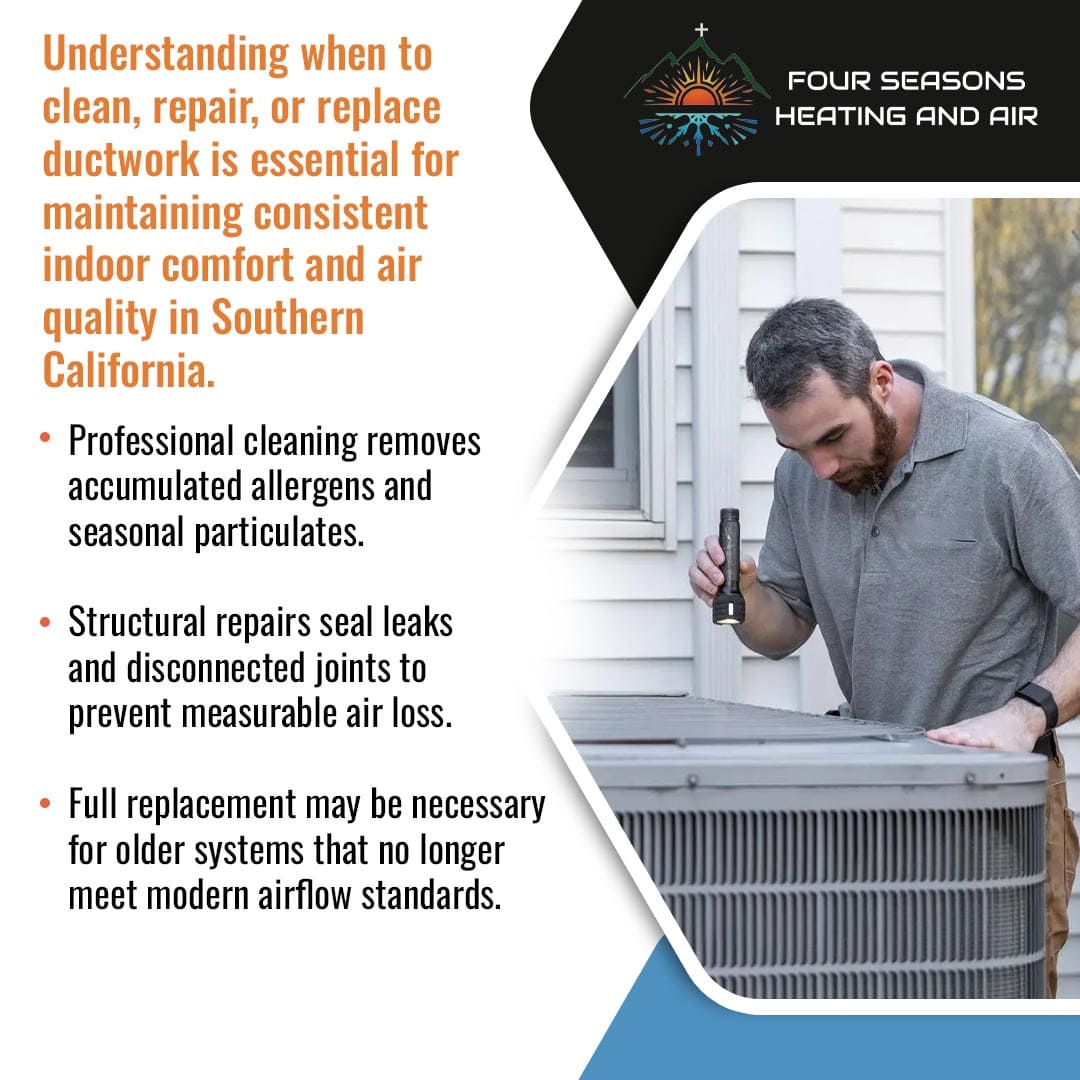
Professional Duct Cleaning
Duct cleaning removes accumulated dust, allergens, and debris from the interior surfaces of the duct system. A professional service uses HEPA-rated (High-Efficiency Particulate Air) negative air pressure equipment to pull contaminants from supply ducts, return ducts, boot connections, plenums, and the air handler without dispersing debris into the living space.
The U.S. Environmental Protection Agency advises that duct cleaning may be appropriate in limited cases, such as visible mold growth, pest infestation, or excessive debris accumulation, while also noting that routine duct cleaning is not generally necessary for most homes.
For Anaheim households near freeways or affected by Santa Ana wind events, which carry fine particulates through HVAC systems, periodic service addresses buildup that standard filter replacements alone do not capture. A structurally sound duct system with years of accumulated debris is a straightforward candidate for cleaning rather than repair or replacement.
Ductwork Repair
Ductwork repair addresses leaks, separated joints, and structural damage that allow conditioned air to escape before reaching the intended rooms. Homes can lose 20 to 30 percent of conditioned air through leaks, holes, and poorly connected ducts. This service restores system integrity without replacing the full installation.
Common repair situations in Anaheim homes include separated flex duct connections at register boots or trunk line takeoffs, gaps at sheet metal joints in older galvanized systems, and torn flex duct sections from attic foot traffic or pest activity.
Repair needs are frequently identified during a duct inspection. When both cleaning and repair are needed, addressing structural issues first produces more lasting results from the cleaning work that follows.
Duct Replacement
Duct replacement is the right path when the existing system is too deteriorated, incorrectly sized, or poorly routed to be restored through cleaning and repair. This applies when ductwork has reached the end of its service life, when materials have degraded beyond practical repair, or when the original installation was never correctly designed for the home.
Full replacement is typically the more practical option when the duct system has undersized supply runs that sealing alone cannot correct, when flex duct materials have deteriorated beyond repair, or when the existing system no longer matches the capacity of the currently installed HVAC equipment.
In Anaheim homes where the original system is 25 or more years old, replacement provides the opportunity to design the system correctly from the start, sized to current standards, routed for reduced resistance, and insulated to Title 24 requirements.
Duct System Performance in Anaheim: Local Conditions and Ongoing Maintenance
Local Conditions That Affect Anaheim Duct Systems
Anaheim’s climate creates specific conditions that accelerate duct wear and particulate buildup compared to cooler or less particulate-heavy regions.
Extended cooling seasons mean HVAC systems in Anaheim operate more hours annually, placing cumulative stress on ductwork seals, insulation, and flex duct materials. Santa Ana wind events carry fine particulates that enter homes through the HVAC system and settle inside ductwork. Wildfire smoke events push fine particles into duct systems that then recirculate through the home until professionally removed. Hot attic temperatures during the summer months accelerate the degradation of flex duct materials and insulation wrap, reducing practical service life.
For many Anaheim households, periodic duct inspections every few years, or sooner if symptoms such as uneven airflow, dust buildup, or system imbalance appear, may help identify issues early.
Maintaining Duct System Performance After Service
A cleaning or repair service produces lasting results when paired with consistent routine upkeep.
Replace the air filter immediately after any professional service and follow a regular replacement schedule, typically every one to three months, depending on filter rating, household size, and whether pets are present. Filters rated MERV 8 through MERV 13 (Minimum Efficiency Reporting Value), a scale measuring filter efficiency across particle size ranges, are commonly used residential filters that can capture a broad range of airborne particles, with higher ratings capturing smaller particles more effectively.
Address any repair recommendations identified during an inspection promptly. Sealing leaks and reconnecting separated joints prevents new contamination from entering through gaps and keeps conditioned air moving toward the rooms it is intended to serve.
Schedule routine HVAC maintenance at least once per year. Coil cleaning, refrigerant level checks, and blower compartment service work alongside a clean, intact duct system to keep the full system operating reliably across Anaheim’s long cooling season.
HVAC Ductwork Services at Four Seasons Heating and Air
Our Duct Inspection Process
Four Seasons Heating and Air conducts every duct inspection with full documentation of what the system contains before any service is recommended. We assess supply ducts, return ducts, boot connections, the main trunk line, plenums, and the air handler, then provide before-and-after records of all work performed.
What We Do After the Inspection
When the inspection identifies a need for duct cleaning, we use HEPA-rated (High-Efficiency Particulate Air) negative air pressure equipment meeting NADCA (National Air Duct Cleaners Association) standards. When ductwork repair is needed, we explain the findings clearly and walk through the available options before any work begins. When duct replacement is the more practical path, we design the replacement system for the home’s actual layout and installed equipment.
Our Standard on Every Job
At Four Seasons Heating and Air, we hold to the same standard on every job across Orange County: straight answers, documented work, and no unnecessary services. Homeowners receive a clear explanation of what the inspection found, what was done, and why.
Frequently Asked Questions
What are the signs of bad ductwork in my home?
Uneven temperatures between rooms, weak airflow at vents, longer system run times, and dust that returns quickly to registers after cleaning are the most common signs of a duct design or leakage problem.
How much conditioned air can leaky ducts waste?
Homes can lose 20 to 30 percent of conditioned air through leaks, holes, and poorly connected ducts, according to ENERGY STAR. That lost air drives up cooling costs and adds run time to the HVAC system.
Should I clean, repair, or replace my ductwork?
Cleaning suits a structurally sound system with accumulated debris. Repair addresses leaks, separated joints, and damage in an otherwise sound system. Replacement makes sense when ducts are severely deteriorated, incorrectly sized, or roughly 25 years old or more.
What is ACCA Manual D duct sizing?
ACCA Manual D is the industry-standard method for calculating correct duct size based on airflow requirements, system pressure, duct length, and the layout of the home. Ducts sized without it are often undersized or oversized for the space they serve.
Is duct cleaning necessary for every home?
No. The EPA notes that routine duct cleaning is not generally necessary for most homes, and is more appropriate in specific cases such as visible mold, pest infestation, or excessive debris accumulation.
How often should ductwork be inspected in Anaheim?
Every few years for most homes, or sooner if symptoms such as uneven airflow, rapid dust buildup, or high static pressure appear. Homes near freeways or affected by Santa Ana wind events may benefit from more frequent checks.
Schedule a Duct Inspection in Anaheim, CA
Poor airflow, uneven temperatures, and rapid dust buildup are all signs that your duct system needs a closer look. Contact Four Seasons Heating and Air at (714) 482-4444 or info@fourseasonsheatingandair.com to schedule an inspection in Anaheim, CA. Whether you are searching for duct cleaning near you or need a full assessment of your HVAC ductwork, we start every job with a documented inspection and a clear explanation of what your system needs.