


Running an air conditioner that produces no cold air is more than a comfort issue in Anaheim. With summer temperatures regularly climbing into the 90s and heat waves pushing past 100 degrees Fahrenheit, a system that runs without cooling puts households at real risk. The problem is not always obvious from the outside. The outdoor unit may be running, the fan may be moving air through the vents, and the thermostat may appear to be responding, yet the indoor temperature keeps rising. That combination of symptoms points to a specific mechanical, refrigerant, or airflow fault, and identifying the correct one requires a licensed technician.
Four Seasons Heating & Air is a veteran-owned HVAC company based in Anaheim, serving homeowners across Orange County with licensed central AC installation, repair, and replacement services. Founded on the principles of honesty, craftsmanship, and accountability, our team brings more than 40 years of combined field experience to every service call. When a homeowner contacts us for AC repair, we do not start with assumptions. We assess the system, identify the fault, and recommend only what the situation requires.
Why Is My AC Running But Not Cooling?
If your AC is running but not cooling your home, one or more parts of the cooling cycle have failed. Here are the most common reasons:
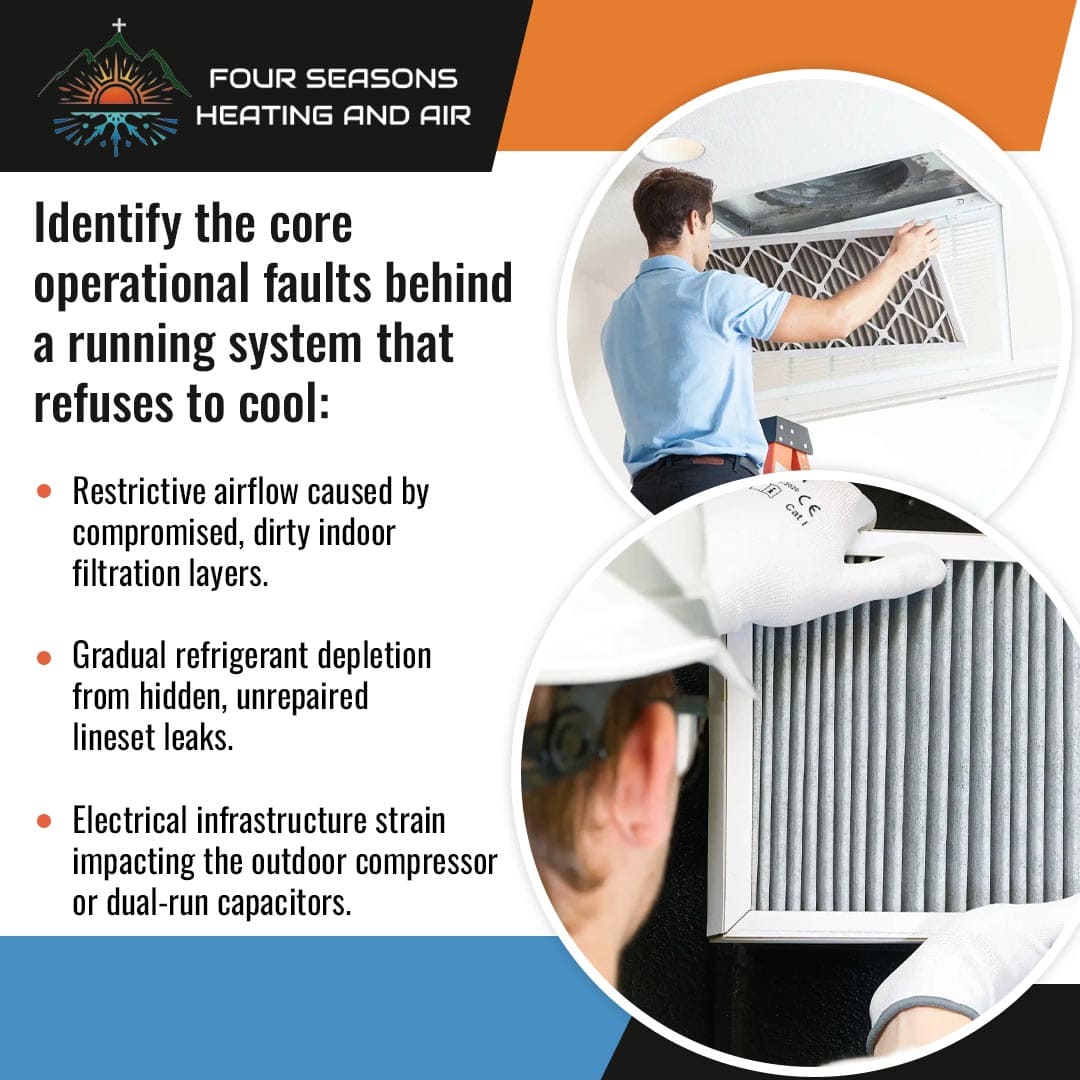
- Dirty or clogged air filter — Restricted airflow starves the system of the air it needs to transfer heat, causing the unit to run without cooling.
- Low refrigerant levels (refrigerant leak) — Refrigerant is the substance that absorbs indoor heat. A leak means there is not enough refrigerant to cool the air, even when the system is running.
- Frozen evaporator coil — Ice buildup on the coil blocks heat absorption, so the system blows air but cannot cool it.
- Blocked or dirty condenser unit — Debris coating the outdoor unit prevents heat from escaping, breaking the cooling cycle.
- Faulty capacitor or failed compressor — These electrical and mechanical failures prevent the system from reaching full cooling capacity, even while it appears to be running.
- Thermostat issues — An incorrectly set, miscalibrated, or malfunctioning thermostat sends the wrong signals to the system, causing it to run without reaching the desired temperature.
- Duct leaks — Cooled air escapes into attic or wall spaces before reaching your living areas, leaving rooms warm despite the system running.
Each of these causes requires a different repair. A licensed HVAC technician can diagnose the exact fault and restore cooling. Read on for a detailed breakdown of each issue.
Common Causes Behind a Central AC Running Without Cooling
A central AC system that runs without producing cold air is experiencing one or more failures in its cooling cycle. The cooling cycle depends on four interconnected components working correctly: the compressor, condenser, expansion valve, and evaporator coil. A fault in any one of these stops effective heat transfer.
The sections below cover the most common causes and what a licensed technician does to address each one.
Refrigerant Loss From a System Leak
Refrigerant is the chemical compound that absorbs indoor heat and carries it outside. When the level drops due to a leak, the system loses its ability to transfer heat and delivers warm air.
Refrigerant does not deplete under normal operation. A low charge almost always points to a leak in the refrigerant lines, evaporator coil, or condenser coil. The U.S. Environmental Protection Agency highlights refrigerant leaks as a significant source of cooling inefficiency and stresses that repairing leaks helps maintain system performance and extend equipment life.
A licensed technician locates the leak using electronic detection or UV dye, repairs the source, and recharges the system to the manufacturer’s specified pressure. Adding refrigerant without fixing the leak does not resolve the fault.
Homeowners with systems using R-22, phased out of U.S. production under EPA regulations as of January 2020, face limited supply and increasing service difficulty. Replacing the unit is often the more practical long-term decision.
Frozen Evaporator Coil
A frozen evaporator coil forms when airflow across the coil drops below the level needed to prevent moisture from freezing on its surface. When ice covers the coil, heat absorption stops, and the system delivers warm air.
The evaporator coil sits inside the air handler and absorbs heat from the air circulating through the home’s duct system. When the coil freezes, it cannot perform that function.
Three conditions most commonly cause a frozen coil:
- A clogged air filter reducing airflow to the air handler
- Blocked supply or return vents restricting circulation
- Low refrigerant charge, which lowers the coil’s surface temperature below freezing
A clogged filter is the most preventable cause. Standard 1-inch filters should be replaced every 30 to 90 days. A frozen coil left unaddressed places additional strain on the compressor and shortens its service life. A licensed technician identifies the root cause, allows the coil to thaw fully, and restores correct airflow before the system is restarted.
Blocked or Dirty Condenser Unit
The condenser (the outdoor unit) releases the heat extracted from indoor air. When the condenser coils are coated in dirt, debris, or plant material, heat cannot escape, and the cooling cycle breaks down.
Anaheim’s warm, dry climate and periodic Santa Ana wind events accelerate debris accumulation on outdoor units. Dust, cottonwood, and dried plant material coat condenser fins and restrict the airflow the unit depends on to function correctly.
HVAC manufacturers generally recommend a minimum of 24 inches of clearance on all sides of the outdoor unit. Overgrown shrubs, stored items, or fencing placed closer than that limit air circulation and reduce the unit’s ability to dissipate heat.
A professional condenser cleaning restores heat transfer, and cooling output often improves within the same service visit.
Capacitor or Compressor Failure
The capacitor provides the electrical surge required to start the compressor and fan motors. When a capacitor weakens or fails, motors cannot start or run at rated speed, and the system stops producing cooled air even while appearing to run.
Capacitor failure is one of the more common single-component failures in central AC systems, particularly in older units exposed to high outdoor temperatures. Signs include a humming sound from the outdoor unit, difficulty starting, or a unit that shuts off shortly after starting.
Capacitor replacement is a straightforward repair completed in a single service visit. Compressor failure is a more serious condition. The compressor is the most mechanically intensive component in a central AC system. When a compressor fails on a unit that is 10 or more years old, full system replacement is frequently the more sound decision. A licensed technician tests both components with appropriate electrical meters and provides a written assessment before any work begins.
Thermostat Malfunction or Miscalibration
A thermostat that reads indoor temperature inaccurately signals the system incorrectly, causing it to run at the wrong times or shut off before the set temperature is reached.
Thermostat issues present in several ways. A thermostat placed in direct sunlight or near a heat-producing appliance reads higher than the actual room temperature, causing the system to run longer than it should. A thermostat with a failing temperature sensor behaves inconsistently regardless of the setting.
Before scheduling a service call, verify three things:
- Thermostat is set to “cool” rather than “fan only,”
- Set point is lower than the current indoor temperature reading,
- No heat sources are near the thermostat’s sensor.
If those conditions are met and the system still does not respond correctly, a technician can test and replace the thermostat as needed.
Duct Leaks and Airflow Losses
Duct leaks allow conditioned air to escape into unconditioned spaces before it reaches the living areas of the home. The system runs, but the cooled air never arrives at its destination.
Ducts that run through attic spaces in Anaheim are particularly vulnerable. Summer attic temperatures in Southern California often rise into the 120–140°F range on hot days, with poorly ventilated attics sometimes exceeding 140°F. When ducts are cracked, separated, or poorly connected in those spaces, cooled air leaks out before it can reach the rooms below.
Observable signs include rooms that stay warmer than others regardless of thermostat settings, rising energy bills without a usage change, and visible separation in accessible duct sections. A technician performs a duct leakage pressure test to locate losses before sealing them.
Each of these faults has a distinct cause and a distinct fix. When a central AC system runs without cooling, the right starting point is a professional diagnosis from a licensed technician who can identify the specific failure rather than guess at it. Anaheim homeowners dealing with any of the conditions above should not have to wait days for a response or settle for a vague assessment. Whether the issue traces back to a refrigerant leak, a frozen coil, or compromised ductwork, Four Seasons Heating & Air provides accurate, straightforward AC repair near you with no guesswork and no unnecessary service recommendations.
When Continued AC Repair No Longer Makes Sense for Anaheim Homeowners
A system that needs repeated service across multiple seasons is telling you something. The question is not whether to schedule another repair. It is whether that repair extends useful life or delays an inevitable replacement.
Anaheim summers are long, and a central AC system here runs harder than it would in most parts of the country. That load accelerates wear on compressors, capacitors, and coil connections. A unit that has been serviced two or three times in recent years and is running without cooling again has likely moved past the point where individual repairs represent sound maintenance.
The distinction matters practically. A refrigerant recharge on a system with a known, repaired leak is a legitimate repair. A refrigerant recharge on a 14-year-old system with an unlocated leak, a history of short cycling, and uneven airflow throughout the home is a different conversation entirely.
R-22 Refrigerant and End-of-Service Systems
The refrigerant type in your system is one of the clearest indicators of where things stand. Systems still running on R-22, which was phased out of U.S. production in January 2020, have no long-term service path. R-22 is no longer manufactured domestically. Supply is finite, and sourcing it becomes more difficult with each passing year. A system dependent on R-22 that develops a refrigerant leak is not a good candidate for repair.
Aging Systems and Efficiency Ratings
SEER2 (Seasonal Energy Efficiency Ratio 2) is the current federal standard for measuring cooling efficiency. Systems installed a decade or more ago often fall well below California’s current minimum threshold, drawing more power to produce less cooling than a modern unit would. That gap shows up on energy bills every month, and the old system continues to run.
At Four Seasons Heating & Air, we review the unit’s age, refrigerant type, service history, and SEER2 rating before making any recommendation. If the system has a productive life ahead, we repair it. If the evidence points the other way, we say so and walk through what an AC replacement would involve for your home.
Emergency AC Repair: Service When the System Fails Completely
When searching for AC repair near you during a system failure, homeowners need a licensed technician who responds the same day, diagnoses the fault on-site, and completes the repair within the same visit when parts are available.
A full AC failure during the summer conditions in Anaheim is not simply an inconvenience. For households with elderly residents, young children, or individuals with medical conditions, it is a health concern that warrants same-day attention.
Emergency central AC repair covers the same range of failures as scheduled service: capacitor and contactor replacement, refrigerant recharge following leak repair, thermostat replacement, and blower motor service. The right company dispatches a technician the same day the call is placed.
Any provider of AC repair near you delivers a written diagnosis and written approval from the homeowner before any work begins, regardless of urgency.

Preventive Maintenance: Reducing the Frequency of AC Repairs
Scheduled preventive maintenance reduces the likelihood of mid-season failures and extends system life. The following practices apply directly to central AC systems in Anaheim’s climate.
- Replace air filters on a consistent schedule. A standard 1-inch pleated filter should be replaced every 30 to 90 days. Homes with pets, high dust exposure, or occupants with respiratory conditions may require more frequent changes. A clogged filter is the most common and most preventable cause of reduced airflow, frozen coils, and compressor strain.
- Keep the condenser unit clear of obstructions. Trim vegetation to maintain the manufacturer-recommended 24-inch clearance on all sides. Remove debris after wind events. Do not store items against or directly above the outdoor unit.
- Schedule an annual pre-season tune-up. A professional maintenance visit before the summer season includes refrigerant pressure verification, electrical connection testing, capacitor testing, coil cleaning, condensate drain clearing, and thermostat calibration. Problems found during routine maintenance are addressed before they escalate.
- Act on early warning signs. Reduced airflow, warm air from vents, unusual sounds during operation, such as grinding, rattling, or clicking on startup, and rising energy bills without a usage change are all early indicators of a developing fault. Addressing them during a scheduled service call avoids extended downtime and more involved repairs later.
Frequently Asked Questions: AC Running But Not Cooling
Why is my AC running but not cooling the house?
The most common causes are a dirty or clogged air filter, low refrigerant from a leak, a frozen evaporator coil, a blocked condenser unit, a failing capacitor or compressor, thermostat problems, or leaky ductwork. Each cause produces the same symptom — the system runs but the air coming out is not cold. A licensed technician can diagnose which issue is affecting your system.
What should I check first if my AC is running but not cooling?
Start with the air filter. A severely clogged filter is the single most common and most preventable cause. Check that it is not packed with dust or debris. Next, confirm the thermostat is set to “cool” (not “fan only”) and that the set temperature is lower than the current room temperature. If both check out and the system still is not cooling, call a licensed HVAC technician — the remaining causes require professional diagnosis.
Can low refrigerant cause my AC to run without cooling?
Yes. Refrigerant is what actually removes heat from the air inside your home. When the refrigerant level drops due to a leak, the system cannot absorb enough heat to cool the air, even while running continuously. A technician must locate and repair the leak, then recharge the system to the correct pressure.
How long does AC repair take in Anaheim?
Most single-component repairs — capacitor replacement, thermostat swap, filter cleaning, or condenser coil cleaning — are completed within the same service visit, typically one to three hours. Refrigerant leak repairs and coil work may take longer depending on the location and severity of the fault. Four Seasons Heating & Air offers same-day service for Anaheim homeowners.
Four Seasons Heating & Air: Licensed AC Installation, Repair, and Replacement in Anaheim
Every technician at Four Seasons Heating & Air arrives at a service call with the same mandate: identify the actual fault, communicate it clearly, and resolve it correctly. That applies whether the job is a single-component AC repair, a full AC replacement, or a new AC installation on a home that has never had central cooling. Our team is fully licensed and insured under California state requirements, and every recommendation is based on what the system actually needs, not on what generates the largest invoice.
As a veteran-owned company, discipline and accountability are not values we state for marketing purposes. They shape how we show up to every job, how we communicate with homeowners, and how we handle the work from start to finish. More than 40 years of combined field experience backs every diagnosis we deliver across Anaheim and the surrounding Orange County communities.
Schedule Your Central AC Repair Service Today
A central AC system that runs without cooling is not a problem to wait out. The longer a faulty system runs under strain, the greater the risk of damage to components that were otherwise still in good condition. Whether the situation calls for a central AC repair or a full AC replacement, Four Seasons Heating & Air delivers an honest assessment grounded in the actual condition of your system. Contact us at (714) 482-4444 or email info@fourseasonsheatingandair.com to schedule a diagnostic service visit.