


Anaheim summers push air conditioners hard. Temperatures regularly climb into the 90s, and periodic heat waves drive conditions past 100°F. Under that kind of demand, a neglected air conditioner does not just underperform. It breaks down. Most mid-season failures do not happen without warning. They happen because warning signs went unaddressed, routine service was skipped, or a system running past its reliable service life was never evaluated. The result is an emergency AC repair call on the hottest day of the year, often for a problem that a scheduled tune-up would have caught months earlier.
Four Seasons Heating & Air is a veteran-owned HVAC company based in Anaheim, serving homeowners across Orange County with more than 40 years of combined experience. From scheduled AC maintenance and repair to full system installations, our licensed and insured team approaches every job with honesty, discipline, and a commitment to doing the work correctly the first time. This guide covers how often professional service should happen, what a tune-up includes, and the conditions that mean a system needs attention before the next scheduled visit.
Standard AC Maintenance Schedule
Most residential central air conditioners need professional service once a year. The U.S. Department of Energy recommends annual maintenance combined with regular filter changes throughout the cooling season.
For Anaheim homeowners, the right time for that annual visit is spring, before the system carries a full cooling load. With summer already approaching, scheduling service now gives a technician the opportunity to find and address any issues before peak heat arrives.
Some households benefit from more frequent attention:
- Homes with multiple pets accumulate dander and debris on coil surfaces faster than pet-free homes, which reduces airflow and heat transfer efficiency.
- Systems 10 years or older are approaching the stage where wear accelerates; twice-yearly inspections give technicians more opportunity to catch component fatigue before it causes a failure.
- Year-round users who run cooling through fall and winter log more operating hours than seasonal users, which shortens the interval between tune-ups.
- Homes with known ductwork issues need more frequent pressure and leakage checks to catch airflow losses before they reduce system performance.
If an air conditioner has gone two or more years without a professional inspection, it is overdue, regardless of how it appears to be running. Systems that seem to be functioning normally can still carry low refrigerant, failing capacitors, or coil buildup that reduces performance without triggering an obvious symptom. Annual service catches those conditions before they become failures.
What a Professional Tune-Up Covers
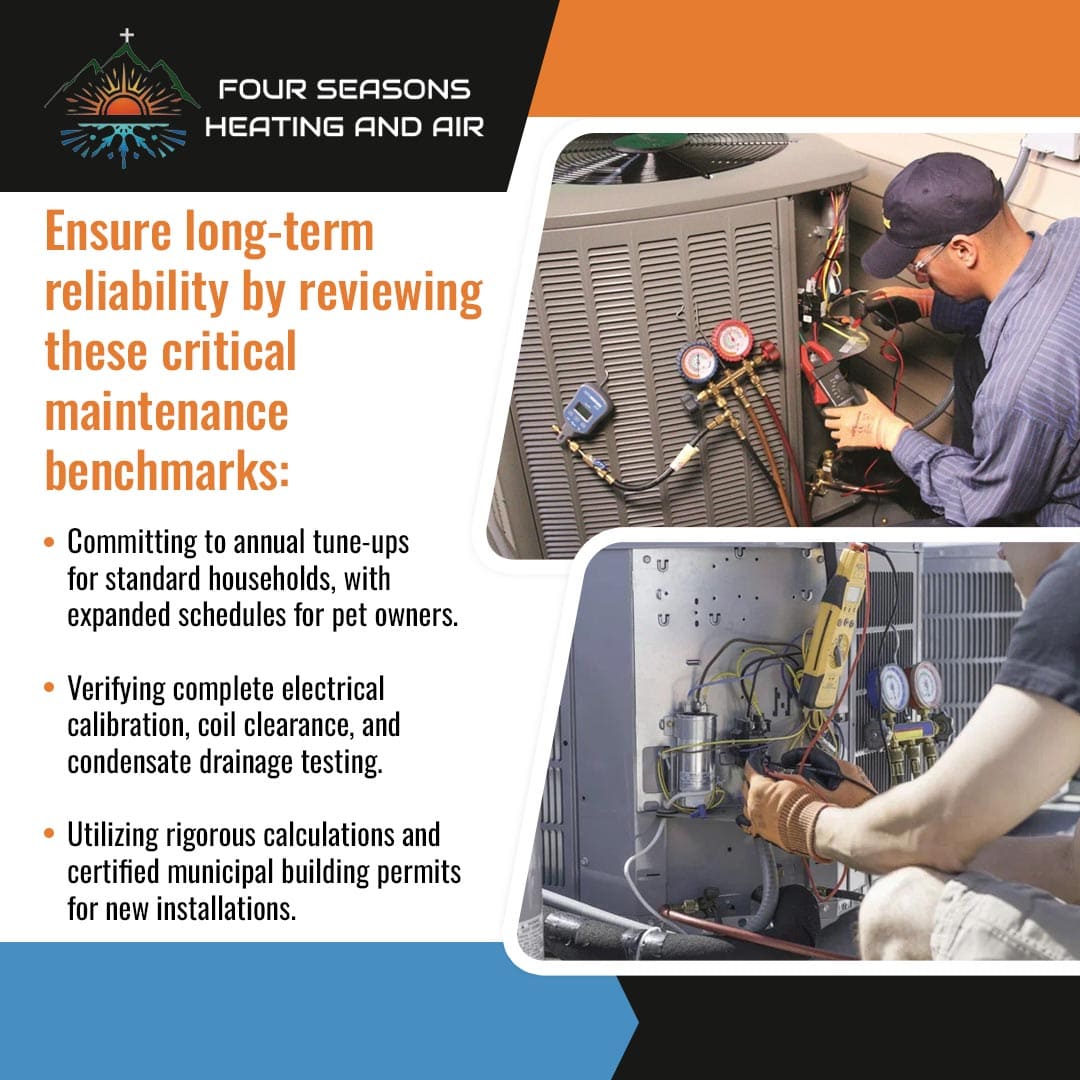
A professional service visit addresses the mechanical, electrical, refrigerant, and airflow components of the system. It is not a filter swap. A licensed technician works through a structured checklist that directly affects how reliably and efficiently the system operates. Each component inspected during that visit connects to the others, and a problem in one area often signals wear in an adjacent one.
Coil Cleaning
The evaporator coil (located in the indoor air handler) and the condenser coil (located in the outdoor unit) both accumulate dirt over time. Dirty coils reduce the heat transfer that the system depends on to cool indoor air. When coil surfaces are fouled with dust and debris, the system runs longer cycles, uses more electricity, and produces less cooling output per hour of operation.
Refrigerant Inspection
Refrigerant is the chemical compound that carries heat out of the home. A system low on refrigerant due to a leak will blow warm air and struggle to reach the thermostat’s set temperature.
A technician checks refrigerant levels and inspects lines and connections for leaks. Adding refrigerant without locating and repairing the source of the loss is a temporary measure that does not resolve the underlying condition. R-22, the refrigerant used in systems manufactured before 2010, was federally phased out of production in 2020 and is no longer available for new system servicing.
Electrical Component Testing
Capacitors and contactors are two of the most frequently replaced electrical components in a residential air conditioner. A capacitor stores and releases electrical charge to start and run the compressor and fan motors. A contactor is the switch that connects line voltage to the compressor when the thermostat calls for cooling.
Both components wear out gradually and often fail without warning, typically on the hottest days when the system is working hardest. A technician tests voltage draws, checks amperage levels, and inspects both components for early signs of wear. Catching a failing capacitor during a scheduled tune-up is far less disruptive than handling an emergency AC repair call on a summer weekend.
Condensate Drain Flush
The evaporator coil removes moisture from indoor air as it cools, and that moisture drains through a condensate line. A clogged drain line causes water to back up into the drain pan, which can overflow and damage ceilings, drywall, or flooring below the air handler. Flushing the condensate drain during a routine tune-up takes a few minutes and prevents water intrusion that can cause mold growth and structural damage.
Thermostat Calibration and Airflow Verification
A thermostat reading even a few degrees off causes the system to run past or stop short of the actual comfort target. Calibration during a maintenance visit keeps the system responding to accurate temperature data.
Airflow verification confirms that conditioned air is reaching every room at the correct volume. A technician checks static pressure readings and inspects accessible ductwork for leaks, disconnected sections, or collapsed flex duct that restricts air distribution.
Scheduling AC maintenance in Anaheim before the cooling season begins gives a technician the opportunity to address all of these components while the system is not yet under peak demand, and before any developing issues have a chance to affect performance.
Knowing When Maintenance Is Not Enough
Routine service keeps a sound system running reliably. But there are times when a technician completing a tune-up or responding to a service call will identify a condition that goes beyond what scheduled AC maintenance can address. Understanding what those conditions look like helps homeowners make informed decisions before a small issue becomes a larger one.
Symptoms That Point to a Needed Repair
Between scheduled visits, the system communicates when something is wrong. The following conditions each indicate a need for professional AC repair before the problem progresses.
- Warm air from the supply vents points to low refrigerant, a dirty evaporator coil, or a compressor beginning to fail. None of these conditions resolves without professional service.
- Short cycling occurs when the system turns on, runs briefly, shuts off, and restarts within minutes. It indicates a refrigerant charge problem, a failing capacitor, or a system sized incorrectly for the home.
- Grinding, rattling, or squealing during operation are mechanical sounds that point to specific component issues. A loose fan blade produces a rhythmic clatter. A failing motor bearing produces a grinding sound. Running the system through those sounds risks turning a manageable situation into a full motor or compressor failure.
- Rooms that stay warm while the rest of the home cools indicate duct leakage, a failing blower motor, or blocked return air pathways.
- Water pooling near the indoor air handler means the condensate drain is blocked or the evaporator coil has iced over. Both conditions require prompt attention to prevent water damage and mold growth.
Acting on these signs promptly keeps the scope of the work contained. A licensed technician handling AC repair can usually address a single failing component far more directly than one responding to a system that has been pushed past that point. Delays often convert a straightforward repair into a more involved one involving secondary components.
When Repair Gives Way to Replacement
Not every repair is worth making. Three factors consistently point toward AC replacement over continued service.
System Age
The average lifespan of a central air conditioner is 15 to 20 years. A system in that range with a pattern of recurring breakdowns is a reasonable candidate for replacement rather than another round of service.
Refrigerant Type
Units still running on R-22 refrigerant have no viable long-term service path. R-22 was federally phased out of production in 2020 and is no longer available for new system servicing. AC replacement is the only practical direction for those units.
Repair Frequency
A useful industry guideline for borderline cases is the “5,000 rule”: multiply the system’s age in years by the estimated repair cost. If the result exceeds 5,000, replacement typically delivers better long-term value. A 14-year-old unit facing a significant repair need will cross that threshold quickly. A 6-year-old unit in the same situation generally will not.
When replacement is the right direction, the process starts with a proper home assessment, not a product selection. A licensed technician performs a Manual J load calculation, the industry-standard sizing method that accounts for square footage, ceiling height, insulation, window orientation, and occupancy, to identify the correct cooling capacity for the specific property. Oversizing causes short cycling and excess humidity. Undersizing causes the system to run continuously without reaching the set temperature. Neither problem can be corrected through service once the wrong equipment is in place. A properly sized AC installation eliminates both risks from the start.
In Anaheim, any AC installation requires a permit filed with the City before work begins. Permitted work complies with California Title 24 energy efficiency standards, protects the manufacturer’s warranty, and preserves the home’s resale value. A contractor who suggests skipping permits should not be hired.
A licensed technician will also check existing ductwork before any new equipment goes in. Homes with leaky or deteriorated ducts lose a substantial share of conditioned air before it reaches the living space. Identifying and addressing those losses during a replacement project means the new system performs as designed from the first day of operation, rather than working against a distribution problem that goes unresolved.
How Four Seasons Heating & Air Handles AC Maintenance in Anaheim
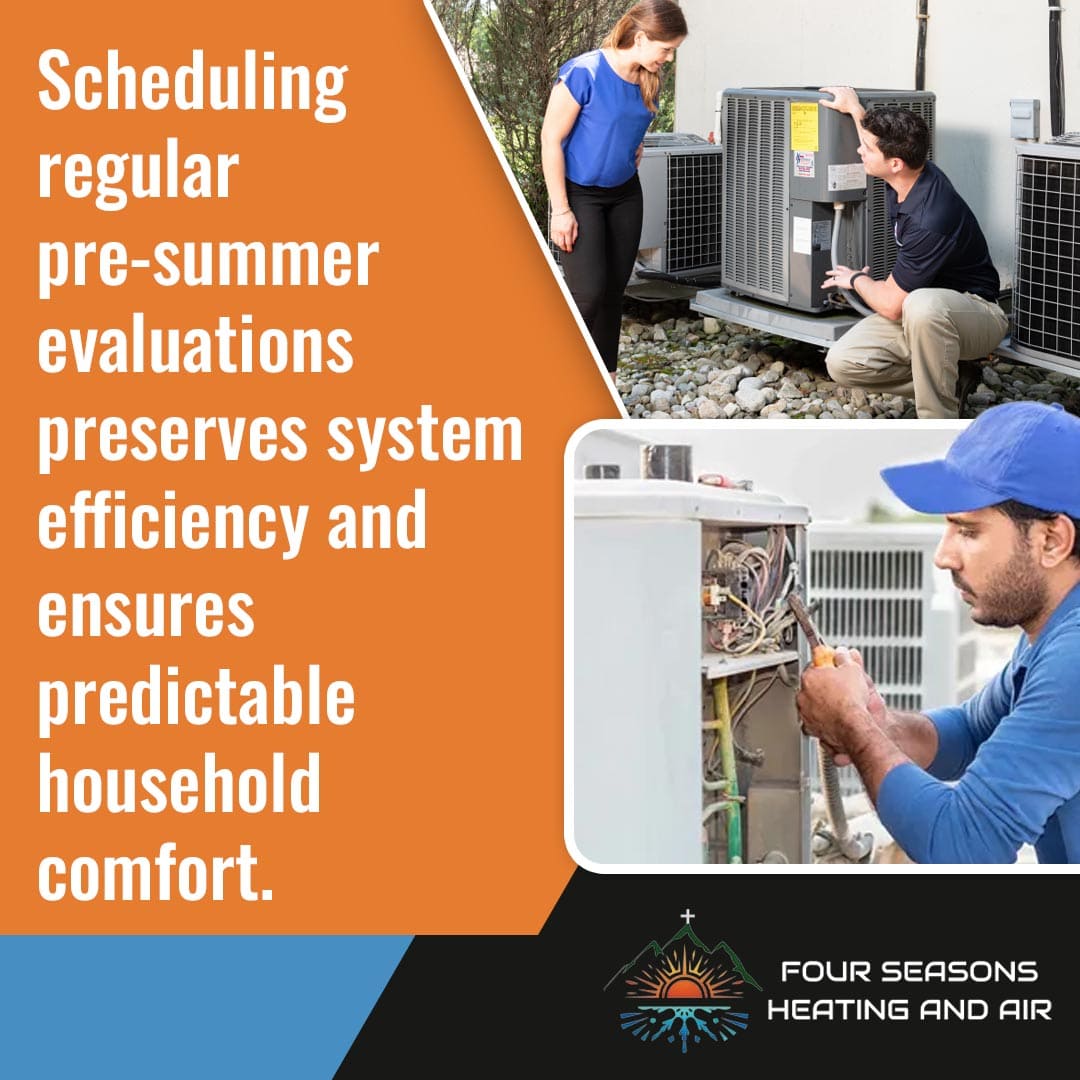
At Four Seasons Heating & Air, every AC maintenance visit follows the same standard: a licensed technician works through the full system checklist, documents what they find, and explains it clearly before leaving. As a veteran-owned company, the work is grounded in a straightforward principle. Homeowners deserve honest service, not a rushed inspection and a bill.
Every technician arrives with the tools and training to handle the full scope of a professional tune-up. Coils, refrigerant levels, electrical components, condensate drain, and airflow each receive the same level of attention regardless of how new or old the system is. If something needs to be addressed, it is documented and explained before any recommendation is made. If a system is running well, the homeowner hears that too.
What Homeowners Experience on a Service Visit
Transparency is built into how our technicians work. Rather than summarizing findings verbally at the door, our team documents conditions with photos and video so homeowners can see exactly what the technician sees. One of our recent customers described the experience after a tune-up:
“The tech came and did a system tune-up. He was very efficient and did a great job. He took pictures and videos so I could see what he was talking about as he explained things to me.” – Lori Z.
Beyond the Inspection
A maintenance visit is also an opportunity to make sure homeowners know how to operate their system effectively. Our technicians take time to walk through thermostat settings, filter change intervals, and anything else that helps a homeowner get the most out of their equipment between visits. A satisfied customer shared the experience after an annual service call:
“I have been very pleased with Four Seasons with their installation and yearly check-up. Hector was very professional and showed me a better way to work the control box. I would recommend this company and service personnel to my friends and family. A+” – Sharon V.
Four Seasons Heating & Air has built its reputation on that kind of service, and it is the same approach that goes into every maintenance visit across Anaheim and the surrounding Orange County areas, regardless of the age of the system or the scope of the job.
AC Service Across Anaheim and Orange County
Four Seasons Heating & Air provides licensed AC maintenance in Anaheim and throughout Orange County, along with AC installation, repair, and AC replacement across Brea, Buena Park, Yorba Linda, Anaheim Hills, Fullerton, Garden Grove, Orange, Placentia, La Habra, and nearby areas.
With more than 40 years of combined experience, our veteran-owned team brings the same disciplined, honest approach to every service call. We assess what the system actually needs, explain our findings clearly, and do the work correctly the first time. No unnecessary recommendations, no shortcuts.
When your air conditioner is due for service, or something does not seem right, contact Four Seasons Heating & Air at (714) 482-4444 or info@fourseasonsheatingandair.com to schedule your visit.